
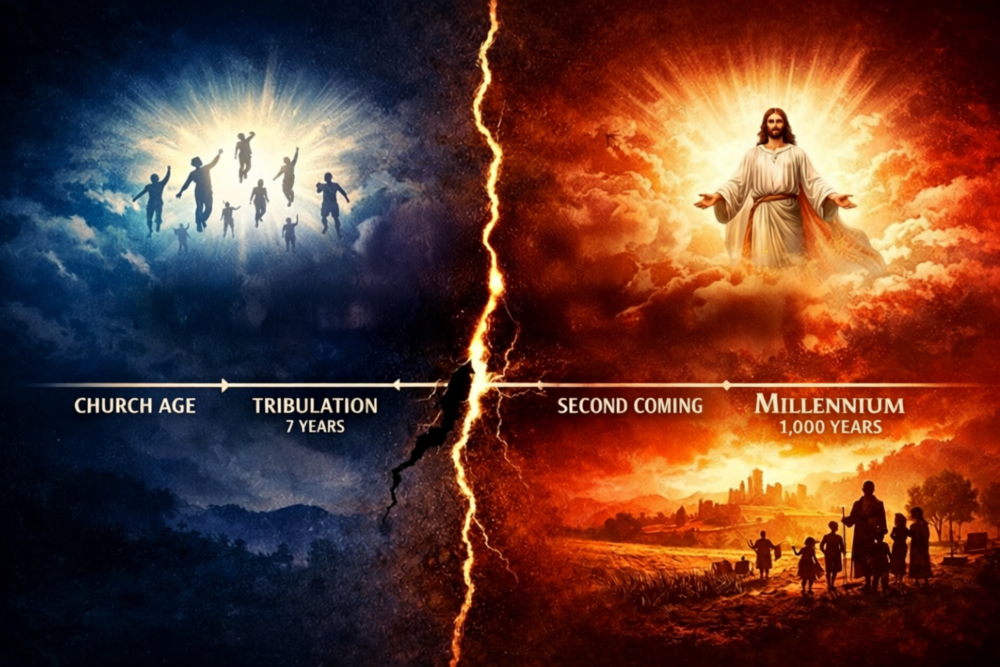
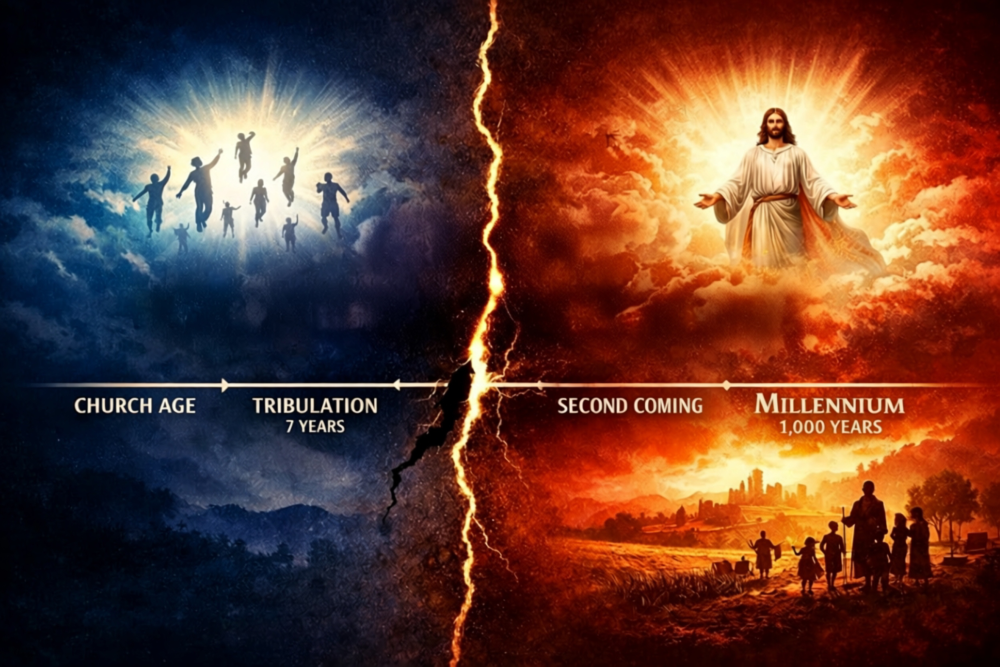
Over the years, people have told me that the Rapture must happen after the seven-year Tribulation. More often than not, they support their belief by offering an assortment of statements supposedly confirming their assertion.
Of course, those who adhere to Replacement Theology combine the Rapture and Second Coming since they reject the tenants of Premillennialists such as a literal seven-year period of judgment and Jesus’ thousand-year reign over the nations that includes a restored Israel. Some amillennialists say they believe in a “post-Tribulation Rapture,” but that’s highly misleading since they view the judgments of Revelation chapters 6-18 as either an allegory, a coded message for first-century saints, or past history. Their definition of the Tribulation differs widely from what the Bible says.
I also hear from many Premillennialists who likewise tell me that the Rapture will take place after the Tribulation. However, those two beliefs contradict each other.
Let me explain why:
A Post-Tribulation Rapture Erases the Distinction Between Israel and the Church
Premillennialists believe that at Jesus’ return to the earth, He will restore a kingdom to a remnant of repentant Jews. Such a scenario is impossible if the Rapture happens at the same time because this entire group would then become part of the resurrected Church. The result of combing the Rapture and Second Coming is that there’s no Israel left to receive the glorious earthly kingdom that the Lord promised the nation throughout the Old Testament.
That’s why I always ask those who place the Rapture after the Tribulation if they are amillennial. I naturally assume they don’t believe in a future for Israel since that viewpoint most often lies behind their assertion. The fulfillment of biblical prophecies pointing to a restoration of a kingdom to Israel necessitates a lengthy gap of time between the Rapture and Second Coming.
Combining the Rapture and Second Coming Eliminates the Possibility of Sin During the Millennium
If everyone enters the period of Jesus’ reign with immortal and incorruptible bodies, how is the rebellion at the end of the Millennium even remotely possible (Revelation 20:7-10)? The Bible describes Jesus’ reign as a time in which He will rule with a “rod of iron” (Psalm 2:9; Revelation 19:15). Since this most definitely is not the church age nor can it possibly be the eternal state, it must be the Millennium when Scripture tells us that sin and rebellion will remain a reality.
The Old Testament prophecies of the Millennium necessitate that people enter this time in natural bodies capable of reproducing and sinning.
Many Post-Tribulation Writers Make the Tribulation about the Church Rather Than Israel
Another contradictory statement that I have heard for many years suggests that believers need the refinement of the Tribulation period for further purification. The latest version I heard of this argument stated that during this time, New Testament saints must “earn the fine linen clothes” awarded at the Marriage Feast of the Lamb. I responded by telling this person his problem was not with the pre-Tribulation Rapture, but rather with a correct understanding of the Gospel.
At it’s heart, suggesting the the Church needs refining during the Tribulation changes one of its key purposes, which is to bring a remnant of the Jewish people to repentance.
Furthermore, the whole idea that we need further purification is wrong on so many levels as is its sister belief in a partial Rapture of only faithful saints. If the words of Ephesians chapters 1 and 2 along with those of Romans 8 are true, then we must thoroughly reject the idea of our need as regenerated saints to experience any further cleansing. Yes, the Lord tests and strengthens our faith in this life, but that’s an entirely different ball game than saying living believers will need a purgatory type of experience during the Tribulation.
If one rejects the Roman Catholic teaching of purgatory after death, why in the world would one suggest that living New Testament saints will need the same type cleansing during the Tribulation period?
Let me put it another way, if our participation in the Rapture depends on anything else than the blood Jesus shed for our sins and His righteousness attributed to us, it will be a nonevent. That’s because apart from our position in Christ, no one would be worthy of participating in it.
There’s Not One Verse!
Many people exclaim that “there’s not one verse in the Bible that supports a pre-Tribulation Rapture!” This strongly resembles similar statements that I have heard such as, “The Bible is full of errors and contradictions!” Or “There’s not one verse that supports Jesus’ deity!” Those who make such misleading statements attempt to persuade others apart from any investigation into the lack of evidence behind such claims.
Please know that a great many verses in the Bible confirm a pre-Tribulation Rapture.
In John 14:2-3, Jesus promises to take us to the place He’s preparing for us in His Father’s House. We also have this same promise stated another way in Colossians 3:4, “When Christ who is your life appears, then you also will appear with him in glory.” It’s clear that when we meet Jesus in the air, we don’t remain on the earth, which is something far different than what happens at the Second Coming.
But how do we know our trip to Heaven happens before the Tribulation? 1 Thessalonians 5:1-11 assures us that the Lord will come for us before the wrath of the Day of the Lord. And this is just one of the many passages that point us to the certainty that Jesus will appear to take us home before the time of wrath reflected in Revelation chapters 6-18. Those who claim that our belief in a pre-Tribulation Rapture is just a “best guess” have not examined the evidence supporting our conviction.
The basic problem with most statements asserting belief in a post-Tribulation Rapture is that they contradict basic Premillennial beliefs. They make it impossible for the Lord to award a kingdom to a repentant Jewish remnant at His return to the earth since they will already be a part of the Church and not a separate entity. And they also negate the possibility of the rebellion at the end of the Millennium as described in Revelation 20:7-10.
Premillennialism Versus a Post-Tribulation Rapture
A couple premillennial authors who claim to believe in a “post-Tribulation” Rapture sought to get around the above contradictions by placing our homegoing before the bowl judgments of Revelation 16. One wrote that we would meet Jesus in the air before this time of wrath and remain airborne with Him until we return to earth with Him. I don’t see anything in Scripture that supports such a scenario. He assumed that the bowl judgments would happen over a relatively short duration of time, which is not necessarily true given their nature.
A more current author believes that just before the start of the bowls of Revelation 16, Jesus will take us to Heaven where we will celebrate the Marriage Supper of the Lamb before joining Him in the Second Coming. What was confusing to me when I read his book was that in part of it, he argues strongly for a post-Tribulation Rapture, but his final position aligns with those who place the Rapture in the middle of the Tribulation.
While I strongly disagree with these writers, their order of events at the end of the Tribulation confirms that a true post-Tribulation Rapture is not at all compatible with Premillennialism. To avoid the inherent contradictions, they sought to allow a period of time between the Rapture and Second Coming.
There’s also a great deal of other evidence in the New Testament that confirms Jesus’ appearing to take us home and the Second Coming cannot possibly be the same event. But aside from that, we recognize that a post-Tribulation Rapture contradicts what Scripture tells us about Israel’s restoration and the very nature of the Millennium.
My book, Invitation to a Lavish Feast – Wisdom’s Path to the Pre-Tribulation Rapture, is available on Amazon or on SkyWatchTV. In this book, I demonstrate how the words of Scripture not only verify our beliefs in not only the restoration of Israel, but also our hope in Jesus’ soon appearing to take us home to glory. In each section, I show how our beliefs regarding Bible prophecy intersect with our lives on a daily basis.
Note: Please consider signing up for my newsletter on the home page of my website at https://www.jonathanbrentner.com/. It will greatly help me in reaching more people. Thanks!