


 This coming October 31st marks the five hundred year anniversary of the beginning of the Reformation. On October 31, 1517 Martin Luther posted his 95 Theses on the door of the Wittenberg Castle Church in Germany. These 95 Theses became the foundation of the Protestant Reformation, which for many restored the biblical ideal of justification by faith and thereby the purity of the Gospel message.
As Luther studied Scripture, he saw that God justifies sinners solely by faith apart from any good works on their part. This challenged centuries of tradition within the church that added human merit to God’s grace as a requirement for salvation.
Both Luther and Calvin rejected the allegorical or symbolical method of interpreting Scripture that, along with human tradition, had introduced error into the churches’ teaching on justification by faith, a doctrine critical to our faith.
Luther replaced the allegorical way of looking at God’s Word with two principles of biblical interpretation, which made Scripture the final authority of all matters of faith and practice and made the Bible a commentary on itself. The later became known as “Scripture interprets Scripture.”
These two principles became the basis for a literal approach to Scripture through which Luther as well as Calvin corrected the errors of the church that had added works to the obtaining of salvation.
They did not, however, apply this literal method of interpretation to the passages dealing with future things. When biblical scholars did so after them, they overturned the long-held Amillennialism of the church; a belief based on an allegorical approach to prophecy. Let me explain what happened after the Reformation.
The Reformers and Amillennialism
Amillennialism is the belief that God has rejected Israel as His people and as such, the church now fulfills “spiritually” the kingdom promises made by the prophets in the Old Testament. As the term suggests, Jesus does not return to restore the kingdom to Israel or reign over the nations for a thousand years. Instead, he comes back at the end of the age to judge humanity and bring in the eternal state.
Although both Luther and Calvin condemned the allegorical method with Calvin going so far as to call it “satanic,” neither challenged the allegorical interpretations that supported the Amillennialism of their day.
Why did this disconnect exist between how the reformers interpreted passages of Scripture relating to salvation versus prophetic passages? Why did they continue to follow an allegorical interpretation when it came to prophecy despite their clear denunciation of such a method?
Their defense of justification by faith alone was enough of a battle and one that desperately needed to happen first.
I believe God intended for the reformers to bring the church back to a true scriptural understanding of the Gospel without the added burden of also reforming errant beliefs regarding the end times. Their defense of justification by faith alone was enough of a battle and one that desperately needed to happen first. God knew He had enough time to correct other beliefs also based on an allegorical method of interpretation.
Did the Reformers fail in regard to eschatology? No, I believe that their two key methods of interpretation became the foundation for Premillennialism as biblical scholars after them applied their literal approach to prophecy.
Isaac Newton
Isaac Newton, born a century after Luther died, undertook an extensive study of the books of Daniel and Revelation during the later years of his life. Newton’s commentary on these books, Observations upon the Prophecies of Daniel and the Apocalypse of St. John, was published six years after his death. In his book, Newton expressed his belief that Israel would someday be a nation again predicting it would happen before the tribulation and the return of Jesus to establish His kingdom on earth after this great time of suffering upon the earth.
Isaac Newton further stated that the study of prophecy would intensify during the latter days of human history as the time of Jesus’ return drew closer. He believed the Lord would reign for a thousand years in Jerusalem thus literally fulfilling kingdom prophecies found in Daniel and Revelation.
Newton applied the Reformers' literal method of biblical interpretation to the books of Daniel rather than the allegorical approach that had been in place for over a thousand years. Did he consciously follow their biblical interpretative methods? We do not know that for sure.
We do know Newton let Scripture speak for itself and as a result his beliefs closely mirror those held by Premillennialists of the past 150 years. While Newton receives much attention for his predictions of when things would occur, once you look past that you see someone who rejected the time honored way of allegorically interpreting the books of Daniel and Revelation.
Later Church History
This pattern of applying the literal method of biblical interpretation to prophetic passages became more widespread in the nineteenth and twentieth centuries. As conservative scholars used Scripture as their sole source of beliefs and allowed Scripture to interpret Scripture, the church returned in large measure to the Premillennial viewpoint that dominated the first three centuries of the church.
Although Luther and Calvin did not apply their literal interpretative methods to prophetic portions of the Bible, when others did it resulted in the beliefs that God would once again restore Israel as a nation, the temple would be rebuilt, there would be a terrible time of tribulation upon the earth, and Jesus would return after that time to set up His kingdom.
These same principles also helped establish the belief that Jesus will come for His church before this time of tribulation upon the earth. Contrary to popular belief, John Darby came up with his pretribulation rapture idea from his study of the nature of the church; he saw that it did not fit for Jesus to allow His church to endure the wrath of the tribulation.
The view that Jesus would return for His church before the tribulation exploded in popularity as many Bible teachers took a literal approach to the words of Scripture. This view dominated evangelical churches from the late 1800's until the past couple decades. Sadly, this view had faded lately as pastors in large numbers have abandoned teaching on this subject.
While perhaps many would disagree with me, I see a link between the biblical interpretation methods of Luther and the rise of premillennialism. Isaac Newton rejected the same allegorical approach as did the Reformers and came to the same conclusions as the premillennialists who followed him a couple centuries later.
Luther’s rejection of the allegorical method restored the biblical doctrine of justification by faith of Paul and the early apostles.
Newton’s rejected of the allegorical method resulted in the restoration of premillennialism, which was dominant in the first three centuries of the church.
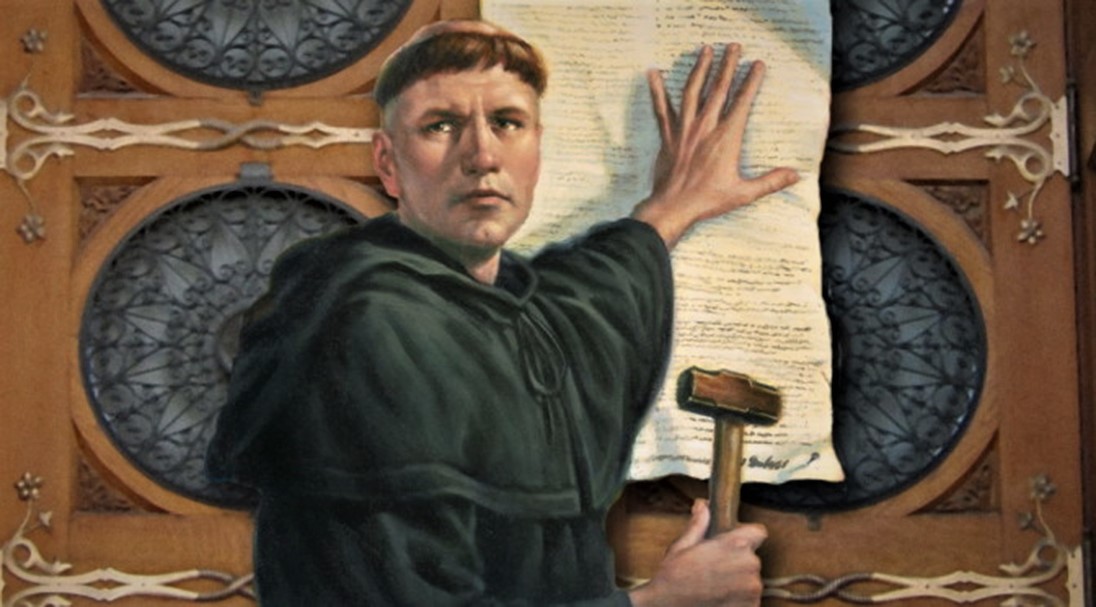 This coming October 31st marks the five hundred year anniversary of the beginning of the Reformation. On October 31, 1517 Martin Luther posted his 95 Theses on the door of the Wittenberg Castle Church in Germany. These 95 Theses became the foundation of the Protestant Reformation, which for many restored the biblical ideal of justification by faith and thereby the purity of the Gospel message.
 “What difference does it make?” Hillary Clinton made this question famous during her Senate questioning of what happened during the September 11, 2012 terrorist attack on the American embassy in Benghazi. Although she did not regard the questions she faced as important, I am sure the answers mattered to those who had lost loved ones in the attack.
 What comes to your mind when you think of a shepherd? For me, it’s wise guidance and protection. I see the shepherd guiding his sheep to a calm, clear lake for a refreshing drink of water and at other times fighting off the attack of a wolf. Perhaps this is why the Lord frequently refers to the leaders of His people in this way.
 “We appear to be suffering a great crisis of hope.” Those words, written by John Eldredge in his September 2017 newsletter, aptly sum up our nation today.
 The news of the Las Vegas massacre shocked me. I watched with great sadness as updated news bulletins increased the death toll seemingly each hour on Monday morning. How could someone be so evil as to murder innocent so many people he did not know? How could he gun them down as though he was a gamer shooting lifeless images on a computer screen?
 Obsession. I think that in many ways this describes the day in which we live. People become obsessed with an idea, interest, desire, or emotion and soon it dominates social media and the news as it consumes everyone’s attention. Everyone reading this post likely knows the nature of the current obsession.
 It always helps when planning a vacation to talk to someone who has already been to the desired destination. They can tell you about what to see as well as what to avoid. The same is true with restaurants, is it not? How many of you have decided not to go to a certain eating establishment after listening to a less than favorable report by someone who had eaten there? Or, on the other hand, how many of you couldn't wait to go to a restaurant because someone raved about its food?
 Based on the feedback I receive from my writing, especially from one of my recent posts, I know some believers question the relevance of what we are seeing today in regard to the return of the Lord. The world has seen natural disasters, earthquakes, and wars since the beginning of recorded history. What’s so significant about the things we are seeing today? Are they really any different than what has happened in earlier times?
 As I drove away I thought, “My faded memories of yesterday are real, not just bad nightmares from so long ago.” I had gone back to the town and to the church building where I was the pastor many years ago. I remembered my high hopes and great excitement for the new ministry opportunity. I absolutely loved being a pastor and desired to accomplish great things for the Lord. Everything in my life suddenly turned upside down while there, however, rivaling any bad dream of my past.
 Last night while we were sleeping, Israeli jets attacked a chemical and biological weapons manufacturing plant in Syria that was operated by the Iranians. It was the largest such airstrike in Syria in the past ten years. The Iranians and Syrians are both furious and vowing revenge.
 During the past several weeks, I have been writing about the resurrection and what it means regarding our beliefs about Jesus, His authority, His teaching, and His views of Scripture. I believe this represents a missing link both in the church and in our nation today. So many want to claim Jesus as a good teacher, but yet fail to believe what He says about so many things. Many Christians worship Him while at the same time expressing disbelief in many of His teachings.
 When I first heard the expression, my immediate thought was “that’s it!” This fits perfectly with what I see.




 Ever since I can remember, I have always thought that if God existed He would surely be able to effectively communicate with us. It never made sense to think of an almighty God that was incapable of conveying His message to us in a clear, accurate, and meaningful way.
 Would Jesus’ teachings fall under the modern day usage of the term Islamophobic?
 Since gravity is true, regardless of our ability to jump we always come back to the ground (I return a bit quicker than most since I can't jump very high). If we drop something, it goes down rather than up. If we trip, we fall unless we regain our balance in time. Since gravity exists, certain things naturally flow from that.